

The Four Steps.
Journal. Reflect. Act. Share.
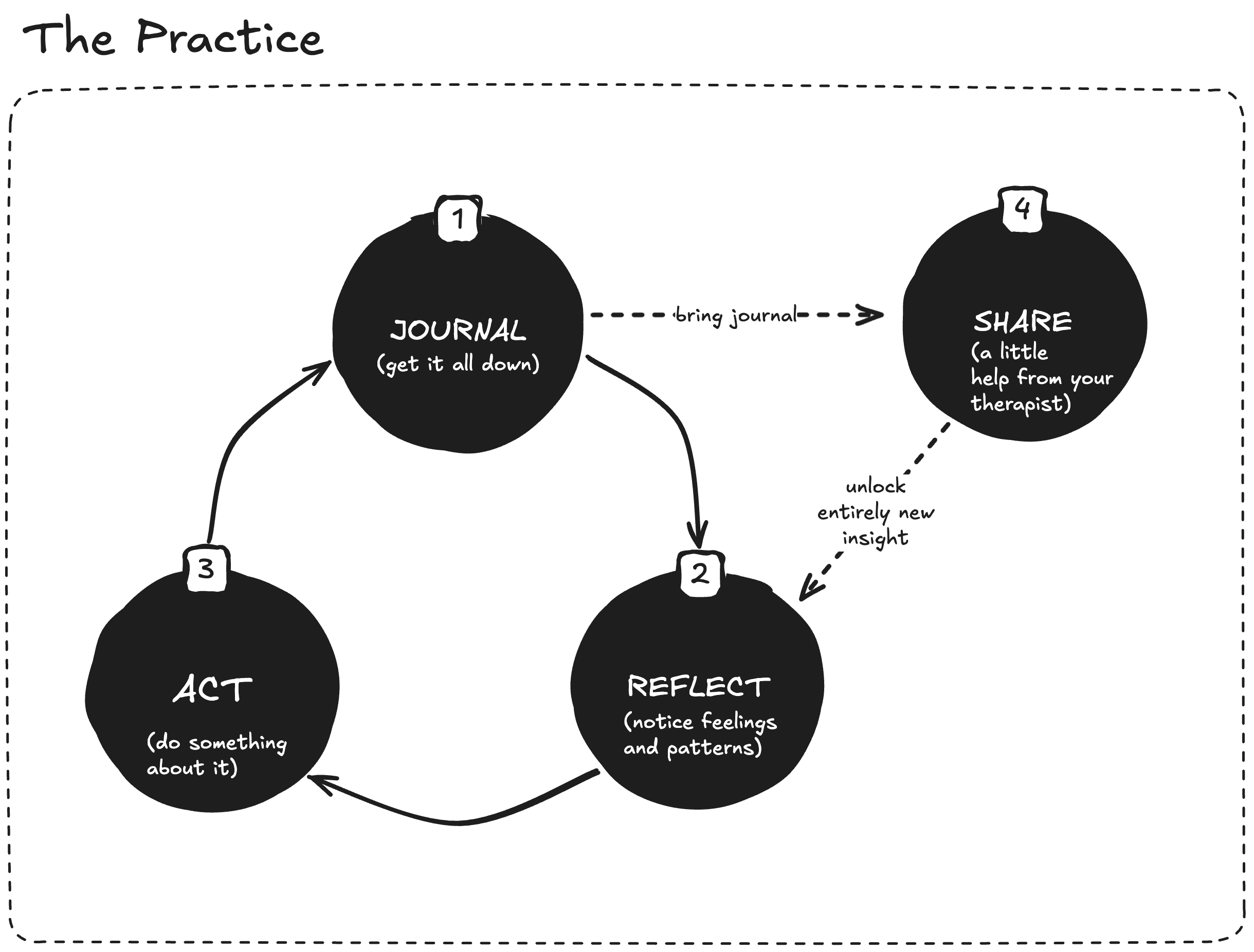
Where Was I is built around a small loop — four steps that feed into each other. You write what's on your mind. You look back for patterns. You act on what you've learned. You share honestly with the people who matter. Then you come back and write again — not from scratch, but from somewhere further along.
This is The Framework. For the daily habits that keep you showing up — morning pages, a weekly walk, and an artist's date — see The Practice. For the longer origin story, read how Where Was I came to be.
Journal
Carry a bucket to the well. Every morning. Before the day gets its hands on you.
The first step is daily free-writing — the practice I do every morning, built for a keyboard. Sit down and write — not for an audience, not for posterity, not to be good at it. Just to get what's in your head down into the well before it calcifies into anxiety or evaporates into nothing. Where Was I sets a 750-word daily target — roughly three pages. It's enough that you can't skate by on a sentence, but not so much that it becomes a chore.
Every entry is a bucket. Some days you won't feel anything shift — the water barely moves, the level stays low, and the page feels like noise. That's fine. That's the point. You're not writing to be answered today. You're building the level it takes to be answered at all. Somewhere, on a day you weren't expecting it, the water is suddenly high enough that something rises with it — a thing you didn't know you were carrying, a connection you hadn't made, an answer to a question you forgot you were asking.
The act of writing is the act of thinking — not a record of thinking you already did.
Your journal doesn't interrupt you, doesn't check its phone, doesn't glance at the clock. It holds everything, judges nothing, and gives you back exactly what you put in — which turns out to be more than you expected. Every entry is both the bucket and the conversation at once. You pour, you talk, and some of what you pour is the talking. The well rises because you kept showing up.
Reflect
Look down. See what the water has lifted.
Cameron tells her students to resist the urge to reread their morning pages right away — to let them accumulate first, and then look back. The magic isn't in any single entry. It's in the patterns that rise across many of them. You keep writing about the same tension at work. You keep mentioning the same friend. Your energy crests and dips with the same rhythms. These aren't coincidences. They've been there all along, finally visible because the water has come up high enough to see them.
Reflection asks you to look across your entries and notice: what is my writing telling me? Where are the consistencies — the things that keep showing up because they genuinely matter? Where are the inconsistencies — the gaps between what you say you value and how you actually spend your time?
Where Was I's analysis tools help surface these patterns, but the real work is yours. A tool can flag that you've mentioned "feeling stuck" in eight of your last twelve entries. Only you can lean over the rim, look at what the water has lifted, and decide what it means.
You already know most of what you need to know. You just haven't sat still long enough to hear it.
This is where journaling stops being a vent and starts becoming a practice. You're no longer just clearing the silt — you're reading what the water reveals. Reading yourself, like a book you're writing one day at a time. The recurring themes are the chapters that matter most.
Act
Carry a bucket back with you.
Reflection surfaces what the water has lifted. Act is where you stand up lighter than you sat down, shoulders back, and take the answer with you.
Cameron pairs morning pages with what she calls the solo date, a weekly solo expedition to tend to the well. Same principle, different direction: an answer is only yours once you act on it. You have to get out of your head and into the world.
This is the step most people skip. They gain the insight, feel the flash of clarity, and then — life. The meeting starts, the kids need something, the phone buzzes. The insight evaporates before it gets anywhere near the rest of the week. Two months later they're writing about the same thing, wondering why nothing changed.
Act is where you convert understanding into intention, and intention into action. You noticed you keep writing about feeling disconnected from your partner — so you commit to one undistracted evening a week. You noticed resentment creeping in at work — so you draft the conversation you've been avoiding. You noticed your energy craters every Sunday night — so you redesign how you spend your weekends.
Intentions you've set. Actions you've committed to. Patterns you're actively working against. All in one place in Act — so when you open your journal tomorrow, you're not starting from scratch. You're picking up where you left off.
The difference between journaling and a journaling practice is this step. Journaling is cathartic. A journaling practice is transformative. One lets you feel better in the moment. The other changes the trajectory.
Insight without action is just
a nice thought you had once.
Share
Let it rain.
By the time you've journaled, reflected, and acted, you know what's actually going on. You've moved past the silt. You have patterns you've noticed, key moments that mattered, questions you're genuinely sitting with. Now comes the hardest part: saying it out loud to someone who matters.
Sharing is the rain. You carry the buckets; you don't get to summon the rain. But the act of being vulnerable — in therapy, with a friend, with a partner — is what calls the weather in. Sometimes that rain comes with tears. That's not a breakdown. That's the weather changing. And rain doesn't just fill your well. It waters the grass that grew back around the clearing, and the roots of the trees nearby. Your growth gives life to the people around you too.
Therapy and psychiatry saved me. They're part of the system — and they work even better when you've already started the conversation with yourself.
Sometimes a therapy session is just venting — and that's fine. That's what it's there for. But when you've already done some of the thinking, the session can start at a higher altitude. You walk in knowing the thread: "Here's the pattern I noticed. Here's what I've tried. Here's where I'm stuck." The conversation goes deeper. And that depth — the honesty, the release — is what brings the rain.
The same goes for the people in your life. When you've been tending to yourself, what you share comes from a clearer place. You're not dumping murky water. You're being honest from a place of care — for yourself and for them. And the rain that falls in those conversations waters more than just your well. It nourishes the whole clearing.
And then the rain comes.
Every honest conversation is rain. Every moment of vulnerability — in therapy, with a friend, with someone you trust enough to be unfinished in front of — sends water back into the well. Not just yours. Theirs too. The rain doesn't fall in a single spot. It feeds the whole clearing. The grass grows back. The wildflowers return. The trees nearby put out new roots.
But rain alone can't sustain a well you've abandoned. You still have to come back, bucket in hand, and pour. And so you return — not from scratch, but from somewhere further along. You open the journal, and you write. The cycle continues.
Journal. Reflect. Act. Share. Each step is an act of tending. Each loop brings you closer to the person you're becoming. It's not a productivity hack or a wellness trend. It's a practice I built over years — daily writing grown into a full cycle — a way of living intentionally, of refusing to let the lessons die before they arrive.
You carry the buckets. The rain comes when it comes. The water rises with both. Each loop, you tend the well a little deeper than the last.
The framework is simple.
Start with step one.
The four steps aren't complicated. The hard part is showing up. Where Was I is the place that makes showing up a little easier.
Start writing — it's freeNeed the daily rhythm first? Read The Practice →